 >
>
Breathe in peace
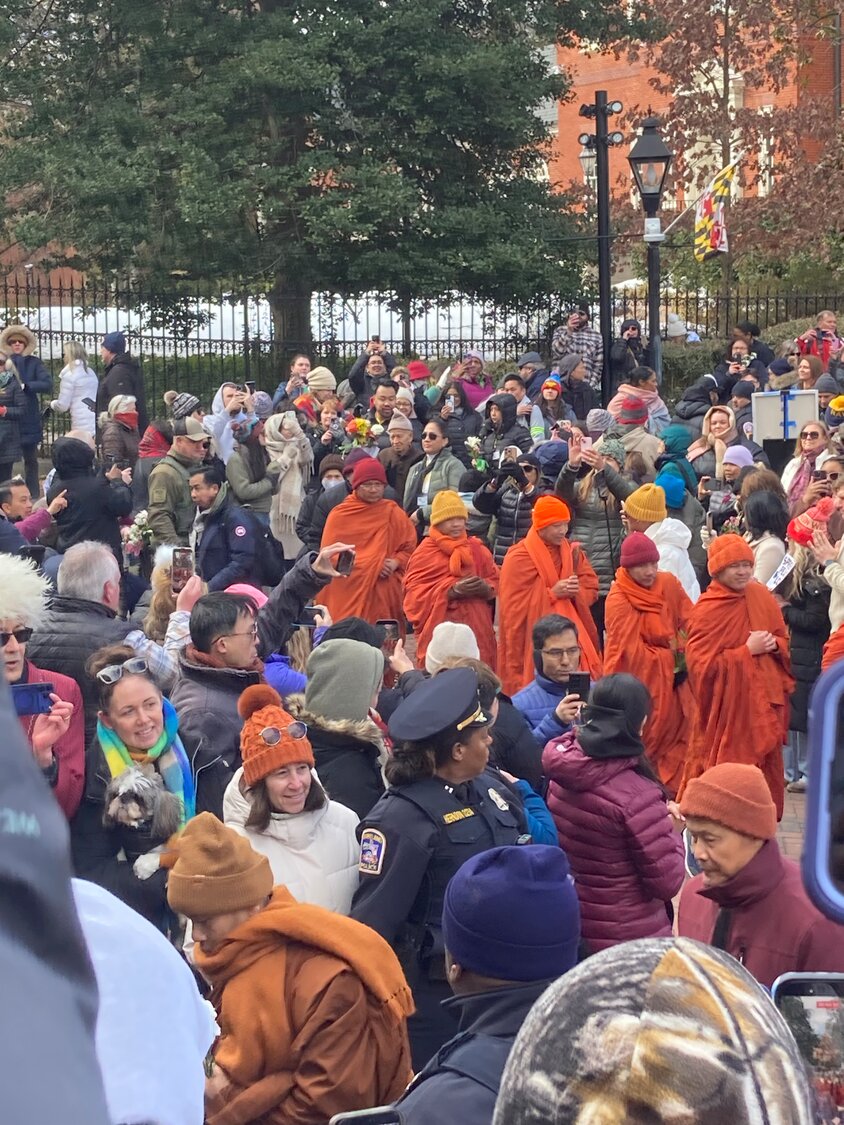


This is a photo of the monks who are on the Walk for Peace as they were walking through Alexandria, Virginia, on Feb. 9. It was sent to me by a friend who was there. She also sent more photos, showing the jubilant crowd upon their arrival on day 107 of their 108-day walk to the Capitol. It was a crisp, cold day with a bright blue sky. The crowd was wrapped in warm coats, scarves, and gloves. The monks walked as they had since October 26. Another witness noted that their eyes were tired, but their smiles were radiant. After the monks passed, the crowds dispersed in a quiet and calm manner. One person was heard to say, “This was definitely worth it.”
Diana Butler Bass, a history of religion professor, author and speaker, quoted the monks in her Substack after she witnessed them passing through her neighborhood near the Potomac River:
“Some people may doubt that our walk can bring peace to the world — and we understand that doubt completely. But everything that has ever mattered began with something impossibly small. A single seed. A first mindful breath. A quiet decision to take one step, then another.
Our walking itself cannot create peace. But when someone encounters us — whether by the roadside, online, or through a friend — when our message touches something deep within them, when it awakens the peace that has always lived quietly in their own heart — something sacred begins to unfold.”
Contrast that sentiment with the venom I witnessed on our streets recently.
On the evening of Jan. 29, several hundred residents gathered to participate in a candlelight prayer vigil hosted by a number of local churches. As the host pastor began with words of welcome, a car horn went off from a vehicle parked nearby. At first, we assumed this was accidental. All of us have unintentionally pressed the wrong button on a key fob. It happened again and again. The vehicle’s owner was nearby, setting off the car’s alarm. As people were leaving, the car owner returned to his vehicle. Two women approached and said they would pray for him. The man unleashed a barrage of nastiness on the women.
Last week, I joined other citizens delivering letters to our Congressman’s local office. Afterwards, we briefly gathered out front. A man walked by and began loudly shouting obscenities. I was close enough to see how red and distorted his face became. He refused any attempt to engage with him in a calm way. His tirade worsened as he continued walking away.
I was shocked that he would yell like that.
Here is a portion of a poem written on Feb. 1, 2026:
What if we do not listen, by Rosemerry
It’s so painful to hear the rhetoric of hate.
Burns like tear gas. Stuns and disorients like flash-bang grenades.
No part of me then can believe there is a sliver of divinity in you.
that I want or need to listen to. It is so hard to listen.
What if we do not listen?
I want to train my ears to hear beneath the invective.
Want to listen beneath the attack.
What if I could hear the human in you and not only the weapons of your words?
What if you could hear the human in me and find a piece of yourself?
I love the honesty of this poem. I can’t help but contrast the monks’ message with what we hear too often on streets and in the media.
I am grateful for poets and writers whose gifts have surfaced during these fraught times.
I am grateful for friends who share with me some sparkling gems they come across.
Here are sections of another poem, shared with me by a fellow choir member. The words were written in response to the halftime brouhaha last weekend, but have a much wider application. My friend is from West Virginia, as is the author.
Halftime in the Holler, by Jennifer Keener
Up here in the hills, we do not ask what color a voice is
when it carries kindness.
I will stand where the hills can hear me
and say what Mamaw always said
when she was a little German girl and
someone tried to sort people into piles:
“Love each other.”
I want a FERNANDINA BEACH (my edit)
where the tap runs clear enough to trust,
where the pantry shelves do not echo,
where nobody is measured by who they pray like or who they love.
A barrier island (my edit)
big enough to hold every neighbor at the table.
After the monks arrived at the National Cathedral, their leader addressed the gathered crowd. He chose to use the opportunity to teach everyone mindfulness through slow, deep breathing, hands on hearts, to feel one’s heartbeat and breath. He led the crowd as they practiced. He discouraged looking at phones first thing in the morning. Instead, he suggested writing by hand the sentence, “Today is going to be an amazing, peaceful day.” What if we made that our daily practice? Would our minds and hearts be able to hear and see each other’s humanity?


Comments
2 comments on this item Please log in to comment by clicking here
Mark Tomes
Thank you, Linda. I try to remind myself that everybody is doing the best they can with what they have. The people who seem the most evil, the most vicious and violent, the worst of the worst, as well as just a person flipping us off as we change lanes or yelling obscenities as we gather in peace, are all just trying to live their lives in a troubled world. What appears to be evil or hate or vengefulness is just fear, fear of losing their identity, their job, their loved ones, their perceived history, their imagined future. Fear is the opposite of love. We cannot imagine what that person has gone through to bring them to this point in their lives, but we can recognize that it must be very difficult for them, to live in fear like that. And we can love them, not pity them, but feel their pain and know that they are trying to reach out into the world, trying to reach us, without crying.
Sunday, February 15 Report this
SantaGRG
Your story is a lovely one. It is sad that some people cannot allow others to peaceably assemble without showing their hostility. My wife and I started following the travels of the Monks very early on. We made a whirlwind trip to South Carolina to see them and have continued to follow their story to their conclusion back in Texas. We also are two of the over one million that have followed their dog. Aloka on Facebook. Let theere be more Peace on Earth and if you have a problem with that, keep quiet.
Sunday, February 15 Report this