 >
>
What could Fernandina’s waterfront look like? New city harbor plan offers two visions

FERNANDINA BEACH - The city's Waterfront Advisory Board will review a draft Harbor Master Plan on Monday that lays out two preliminary concepts for extending public access, marina facilities and flood protection north along the Amelia River while preserving space for commercial fishing and marine businesses.
The 45-page Phase 1 study, prepared by Moffatt & Nichol and dated Sept. 14, covers approximately nine waterfront parcels extending north along North Front Street from the Simmons property to Beacon Fisheries. Only one of the parcels is city-owned; the remainder are privately owned or port-related.
The plan being presented Monday is preliminary. It does not select a preferred alternative or provide construction cost estimates. A proposed second phase would expand public involvement, conduct additional technical and feasibility analysis, refine the concepts, select a preferred plan and develop probable construction costs, permitting steps and an implementation strategy.
Much of the Phase 1 work was based on discussions with owners of waterfront properties north of the city marina.
Broader public outreach was not included in Phase 1. The report says that would occur as part of Phase 2.
Consultants met with the owners of the Simmons, Goodsell, Kavanaugh and Liebman properties and incorporated their stated interests into the planning process.
As a result, some of the uses illustrated on those properties are planning concepts developed by the consultants rather than proposals submitted by the property owners.
The major difference is how far public-oriented development would extend north before transitioning to the more industrial working waterfront.
Concept B draws a sharper line between the two areas. Community-oriented commercial and public uses would be concentrated closer to downtown and the marina, with the Liebman property serving as the transition to more intensive maritime uses farther north.
Both concepts make the city-owned property at 101 N. Front St., at the foot of Alachua Street, a major public waterfront site.

The consultants recommend moving ahead with more detailed planning and early design of the city property to improve the city’s ability to compete for grants.
The existing waterfront resilience wall extends north to the Simmons property. The consultants recommend evaluating an extension through the city-owned parcel and the Goodsell, Kavanaugh and Liebman properties.
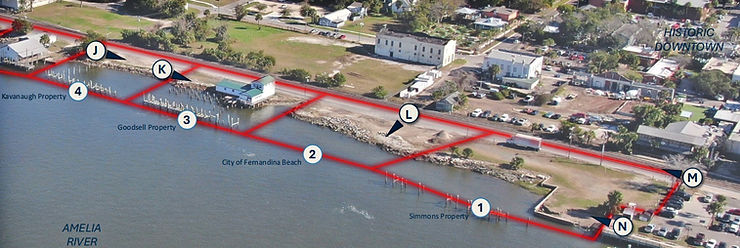
During discussions with consultants in May, the owner presented the Amelia Wharf concept for a mixed-use waterfront development built around an internal pedestrian corridor with retail and restaurant uses. The proposal includes a waterfront restaurant with outdoor dining and public access along the river.
The consultants said the Simmons project needs to be coordinated with the city’s marina planning. Privately developed slips could affect the ability to expand or reconfigure the municipal marina and could interfere with public marine improvements extending from the north.
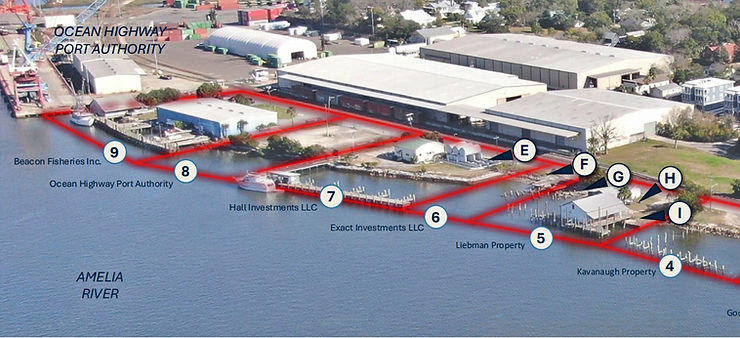
The Liebman property presents a different issue.
Moffatt & Nichol describes the Liebman building as the most significant surviving heritage building along that portion of the waterfront and recommends pursuing its preservation and adaptive reuse. The consultants said restoration could be technically difficult and expensive because the structure may have to be elevated or its foundation reconstructed as part of future flood-protection improvements.
The report says the city should consider the property as a possible strategic acquisition. Because of its limited width, consultants concluded it may have more value when combined with neighboring property than if developed independently. Potential uses include pedestrian access, landscaping, viewing areas and a more natural shoreline treatment.
The Ocean Highway and Port Authority property is currently used primarily for marine-related storage, truck staging and overflow associated with port operations. The plan does not identify a specific redevelopment proposal for the property.
The property is being marketed for approximately $6.5 million, according to the study. It includes approximately 12,000 square feet of warehouse and cold-storage space, a separate 1,410-square-foot former restaurant building and docks with direct deep-water access.
The entire Phase 1 planning area lies within the Amelia River Waterfront Community Redevelopment Area, established in 2005. Tax-increment financing generated within the CRA can be used for public infrastructure, waterfront access, resilience improvements, streetscape work and property acquisition. The CRA is authorized through 2053.


Comments
3 comments on this item Please log in to comment by clicking here
Mark Tomes
Ask nearly anyone who lives in a city or town that has a waterfront downtown (and who does not have a financial interest in it), and they will tell you they like pedestrian access, wide open spaces and views, public gathering places, very little commercial activity, places to jog and throw frisbees and have picnics and watch the boats and clouds go by. Why are we continuing to see plans that are almost just the complete opposite? (Money, money, money.) Just like we are praising the city leaders from the 1970s in establishing the Greenway, our current leaders should be thinking about keeping that entire waterfront open for future generations.
4 days ago Report this
ahefterhughes
It's insane to suggest that the city buys all of these properties. The taxpayers can't afford it! Can you imagine what that would cost?
And the taxpayers just footed the bill for the waterfront park. Isn't that supposed to meet the needs of the community for waterfront access?
Also, please stop drawing renderings from the river! What will it look like from the street to the average pedestrian?
2 days ago Report this
FRANKH
I am fascinated by the question, “What could Fernandina’s waterfront look like.” My wife and I are relatively new residents and just completed building a home on southern Amelia island. Fernandina has a very complicated makeup of residents. There are multigenerational residents, newly arrived residents, and all those in between. While looking for a home I learned about the RYAM facility and the proposed ethanol manufacturing project. I got involved with No Ethanol Fernandina (NEF) and now serve as the President of the Board of Directors. In this role I have learned a lot about the diverse and often conflicting viewpoints regarding the development of Fernandina and Amelia Island. I am still learning. I believe the two phase approach to the waterfront development planning can be successful. The description of phase one is an abbreviated version of what to expect in phase two. The City must be prepared and committed to facilitating and considering all of the different views they should be anticipating. As a lawyer/lobbyist I participated in a lot of large developments. The City must schedule public forums and listen …
Yesterday at 1:35 AM Report this