 >
>
The eagle and the rattlesnake
Exploring the treasures of Martins Island

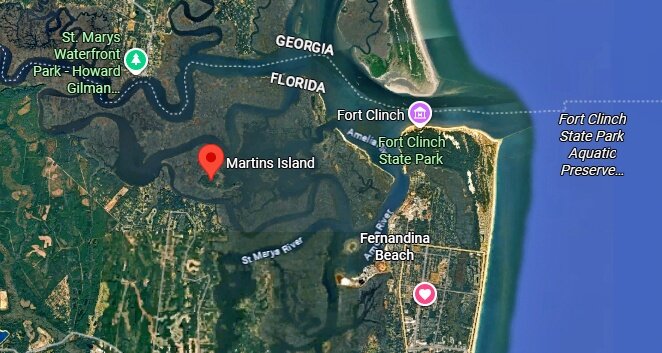
Martins Island is located between tributaries of the St. Marys River, two miles south of the Georgia border and four miles due west of Fernandina Beach’s historic downtown. The first record of ownership of Martins Island dates back to a Spanish land grant in 1828 to Robert Miller.
The island was known to have indigo and rice cultivation sometime in the 1800s. In more modern times, developers planned to build 56 homes on this 105-acre island. Fortunately, the Trust for Public Land worked to obtain protection of this pristine barrier island, securing public ownership in 2003. At that time the island was slated for ecotourism and educational activities overseen by Fort Clinch State Park. But for the most part, this island remains wild and peaceful, with very few human visitors.
In 2016, a friend and I had a tip that there was a bald eagle nest on Martins Island. We decided to visit the nest, planning to keep a respectful distance.
On a sunny day in May, we set off for Martins Island, launching our kayaks from a private dock at the end of Chester Road. Not knowing our way through the meandering channels of the marsh, we asked some fishermen how to get to the island. They pointed us in the right direction but expressed doubt that we could get onto the island. They informed us that mudflats surrounded the island and it was impossible to come to shore at low tide.
As we approached the island, we understood their warning. The shore was well over 100 feet from the water and the distance was spanned by an unforgiving tidal mudflat. We had no idea how we would cross this distance with our kayaks, but quickly came up with an idea. We both stood on one kayak and scooted the other kayak forward, alternating standing on one kayak and then the other, moving slowly toward the island. By the time we made it to the boat dock, we were covered in mud!
The island has remains of a small building and a picnic table near the dock but little other evidence of human activity.
The island’s maritime forest is very dense, so we walked along the edge of the marsh instead of struggling through the center of the island. We headed toward where we believed the eagle nest was located, seeing a large dense mass in one of the distant pine trees.
We approached the area, staying back a legal distance from the nest, so as not to disturb the bald eagles. I began to notice a white substance on the ground, I believed were bird droppings. I took another step and froze! Only a few feet in front of me was a very large eastern diamondback rattlesnake camouflaged among the fallen magnolia leaves.
Staying perfectly still, I tried to take in the scene. The snake was absolutely beautiful, had a distinctive, bright pattern and was about 6 to 7 feet long. The rattler was so calm; it made me calm. The snake’s middle section was the size of a football, indicating it had just ingested a large meal. It was totally unconcerned by our presence.
We slowly moved around the snake and climbed onto a horizontal tree branch about three feet off the ground. We felt safe from our perch, having a good vantage point to view this amazing creature. The first thing that came to my mind was that the rattlesnake had also come for the eagle nest. Reptiles in Florida know what happens in the month of May; they understand fledgling birds will attempt their first flight, unsuccessfully, and land on the ground. In an ancient ritual of survival, predators like alligators and snakes patiently wait for a meal beneath the nests of birds.
Our trip to the untamed Martins Island is one of my most memorable adventures.
We had worked hard to get on that island, creating for ourselves a unique opportunity to be on a remote, uninhabited barrier island surrounded by the wild beauty of northeast Florida. We experienced two of the most iconic and impressive creatures in America — the bald eagle and the rattlesnake. I will always wonder whether we witnessed an eastern diamondback rattlesnake ingesting a fledgling bald eagle, but I will never know for sure.


Comments
1 comment on this item Please log in to comment by clicking here
Mark Tomes
I have been monitoring the eagle nest on Martin's Island for the Audubon Society for a number of years, including one in a different tree that blew down a few years ago. This is a very bashful pair, and they will fly away when approached by people well beyond the legal limit. Fortunately, we are near the end of nesting season, and the fledglings can handle some disturbances. But, please, just bring your binoculars and look at them from far away, so as not to disturb these beautiful animals. If you'd like to become a bald eagle nest monitor, just google EagleWatch Florida for more information.
Thursday, April 23 Report this