 >
>
Pat’s Wildways: Maritime forest walk




Lately, our remaining patches of maritime forests are on my mind. It started when my friends Susan and Flip showed me a bike trail in the Egans Creek Greenway that I had never traversed. It’s a little patch of protected maritime forest just north of Jasmine Street with signs indicating this island treasure. We spent this walk marveling at the interesting trunk formations, with hollows inside fit for a Hobbit, and large tree trunks intertwined. How have I missed this trail before?
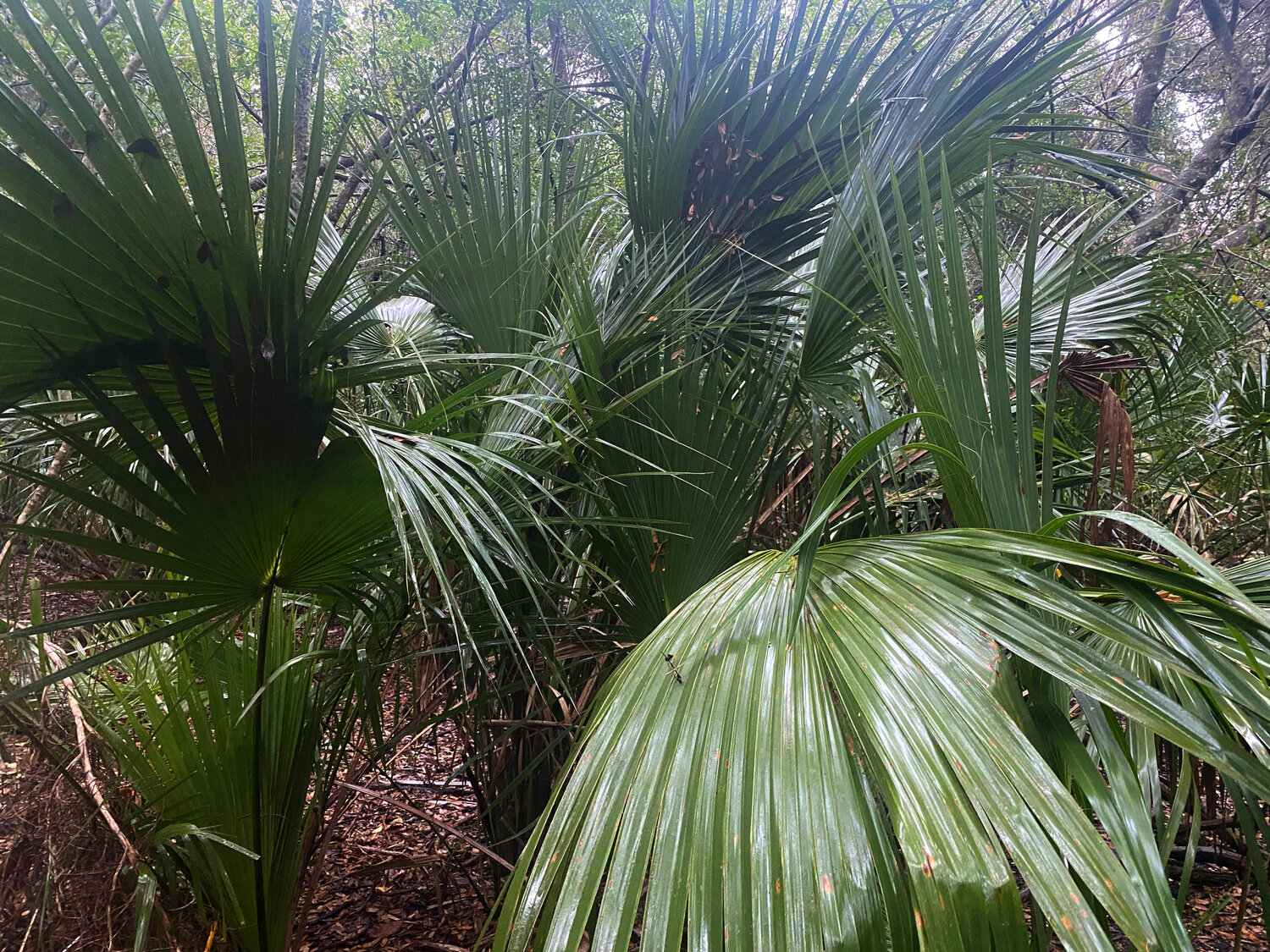
I’m of course very familiar with the much larger area of maritime forest in Fort Clinch State Park, but this little trail gives an up-close and personal view of the massive oaks, magnolias, sabal palms and other species that seemed to have evaded any massive woodcutting as our island was developed. A recent GIS study by Len Pearlstine estimates that there are about 664 acres of maritime forest left on Amelia Island, mostly in Fort Clinch and Amelia State Parks. But this little path, developed for off-road biking, highlights another bit of maritime forest, too, and it’s impressive. Magnolia trees with trunks too thick to surround with the arms of two people, sabal palms reaching into the sky, giant historic live oaks protecting the canopy — it’s all there to admire in a short walk in the woods.
Ever since I’ve “discovered” this trail I keep returning. In a bit of a coincidence, Carol Ruckdeschel and her friends were visiting Amelia Island and invited me to lunch to discuss our upcoming presentation in the Festival of Stories & Songs at the end of this month. Carol, as many might know, has lived modestly on the north end of Cumberland Island for decades, chronicling the wildlife and natural features over the years and amassing a large collection of native species that now reside in part at the Smithsonian and other notable institutions. Carol knows more about the nature of Cumberland Island than anyone. And now, Carol is most concerned about threats there to its remaining parcels of maritime forest habitat.
So, of course, after lunch, I just had to take Carol and Charlotte Fries to this trail. And with these two naturalist experts on hand, I learned so much more. As we walked through the woods, I learned that most of the low-lying palm shrubs were cabbage palms, which would eventually mature into tall, standing palms towering over the canopy. Also known as sabal palms, this is the state tree of Florida, but gets its alternate name from the fact that parts of the palm are edible, although regrettably, that kills the plant. Another palm in the area is the saw palmetto, which looks similar to young cabbage palms but if you try to walk through a patch of them the “saw” in their name becomes evident. These palms can hurt you! But their berries, called drupes, that hang in bunches, have all kinds of medicinal properties and have spawned an entire enterprise in Florida where people harvest, process and sell them. These drupes, though, are an important food for wildlife in the forest, and when they are over-harvested, this presents a danger to the survival of a number of species. For this reason, permits are necessary to harvest drupes, and this is only allowed in some areas.
The most impressive trees on this trail are large, mature magnolias, live oaks, and cedars that hug the path, and in some cases require a hiker to step over the roots or through tight passages between them. It is a fun walk for sure, with always something new to see. After my walk with Carol and Charlotte, I went back on a rainy day to discover more on my own. This time, I was delighted to see raindrop patterns on spider webs, colorful lichens on tree trunks, and patches of yellow shelf fungi devouring a dead tree. And I’m sure the next time I go, I will admire something else.
I know I will return to this short hike now throughout the seasons, with an eye to spotting anything new that crops up as the weather changes. For anyone who wants a short “walk in the woods,” check out this trail. Maybe I’ll see you there. I will be back!
Pat Foster-Turley, Ph.D., is a zoologist on Amelia Island. She welcomes your nature questions and observations. patandbucko@yahoo.com


Comments
1 comment on this item Please log in to comment by clicking here
Mark Tomes
Pat, thanks for pointing out this wonderful trail. There's another one on the southwest side of the Eagans Creek Preserve, also. Both are very fun single track mountain bike trails, too, but bike-riding on them do tend to mess up the trails and make them muddy.
Saturday, January 24 Report this