 >
>
Pat's Wildways: Mango Time!
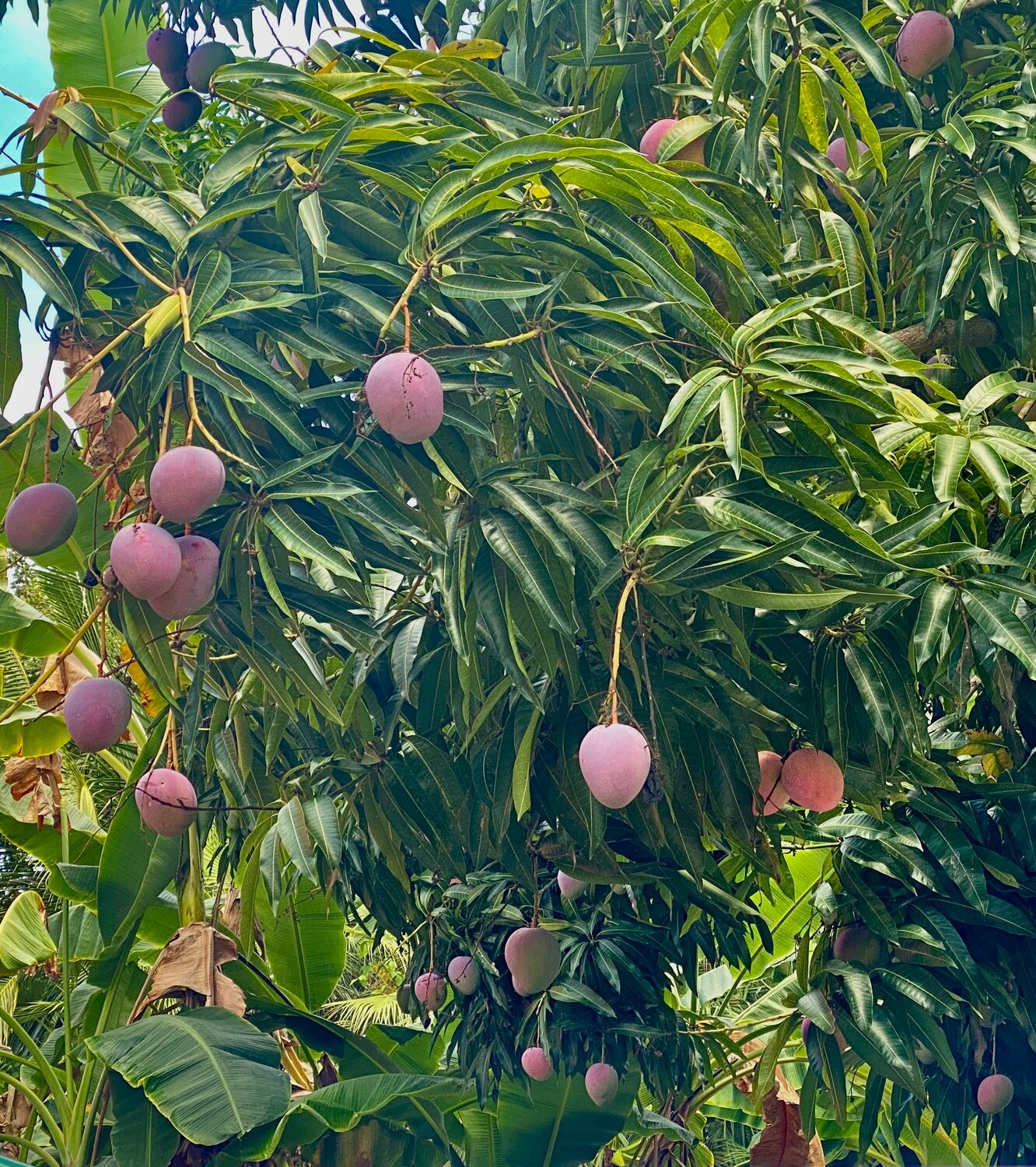


I usually don’t go for fruit if given a choice, but for me, mangos are something different. They are the best of the fruiting world, in my opinion at least. And am I in luck! This trip to Belize, it is mango season! Everywhere I look, there are mangos: on the ground, on the trees, people eating mangos as they walk through the village, people giving them to me, mangos in recipes. The next town up the coast, Hopkins, was celebrating its annual Mango Festival.
Placencia has a plethora of mango species — about 15 different cultivars, and everyone has their favorite. One has a thin skin, the black mango, and you can eat the skin too, just like an apple. Most have tougher skin, are usually not eaten, and the flesh inside has subtly different flavor profiles depending on the type. One mango is shaped like an apple, and others have a deep, rosy color when ripe. One has stringy flesh. Yet another has a slightly garlicky aftertaste. In my mind, all are delicious.
When I walk along the sidewalks of Placencia, there are fallen perfect mangos everywhere, just too many for people to consume. People pick them up and eat them as they walk to their destination. Some people have bins of mangos on their front stoop, free for the taking. Some Belizean friends of mine gift me with mangos as I pass by. More entrepreneurial types try to sell them to tourists. Hey, a bit of extra income never hurt anyone.
On our walk to dinner one evening, we watched some locals tossing a coconut into a mango tree, trying to dislodge them, with some success among many tries. I’ve read that this process is called “stoning” mangoes, and has been passed down through generations of Belizeans. It was fun to watch it in action.
In our two weeks here during mango season, I am becoming a connoisseur. It’s been pointed out to me that some mangos have worms. The fruit looks perfect unless you know. It takes some careful inspection to see a small nondescript hole where juice comes out if you squeeze it a bit. But the best sign of wormy mangos is seeing lots of perfect-looking ripe mangoes under a tree that no one has picked. I’ve read that these small “worms” are the maggots of fruit flies and they generally only infect one tree, or those in a particular area. I cut one open to inspect it. Yuck. But Belizeans are practical people. If you only have wormy mangos, no problem, just cut the wormy parts out and eat the rest. Or as one local told me, “When I was a kid, my parents only gave me mangoes to eat when it was dark!”
One nearby tree produces a mango relative right now too — cashews. These scatter on the ground below that tree and they purportedly taste sweet and similar to mangos, but none are in an edible state when I see them. The “nut” we call cashew is that projection on the side of the fruit, and it takes a lot of work to prepare it, what with the toxic fumes of urushiol (the same compound that is in poison ivy) when roasted. And hand-processed cashews cost a small fortune, as they should, considering the work involved in preparing them. Most locals don’t deal with the nut but enjoy cashew fruit and juice.
During our days here, I’ve been eating my fair share of mangos and lining up the excess on my windowsill. In honor of this column, I cut them all up and did my own comparison. Looks like I ended up with at least three distinct cultivars, maybe more. I don’t have the knowledge to identify them and Google was no help, but I can tell you that the big one was extra juicy with a sweet flavor. The smaller red skin one was similar but not as juicy, with a bit of tartness. And the small greenish one tasted a lot like the big one, only better. It was my favorite. Now, what tree did I get this from? Who knows?
What I do know is I will be back in Placencia soon enough again to learn more about something or another. It’s always something.
Pat Foster-Turley, Ph.D., is a zoologist on Amelia Island. She welcomes your nature questions and observations. Patandbucko@yahoo.com


Comments
No comments on this item Please log in to comment by clicking here