 >
>
Pat’s Wildways: Arizona north to south




Arizona doesn’t look all that large on an overall map of the United States. I convinced Bucko to do a 10-night road trip there to see my bucket list item of Antelope Canyon in the northwest and then to stay a few days at my favorite retreat in the far southeast of the state. Let me tell you, Arizona is big!
In Page the night before our Antelope Canyon tour, I hoped to get a beautiful sunset shot and we followed some internet instructions to get to the “best vantage point.” Sadly, it was beyond our capabilities to hike down a bunch of natural free-form steps to the viewpoint. No matter. We found another nearby spot to sit and watch the day turn to twilight. Peaceful, beautiful and just us. Perfect.
Northern Arizona is a landscape of red rock formations, slot canyons and wide open spaces between them, with much of the land contained in Native American reservations. Bucko and I drove miles and miles through this barren-looking landscape — “just rock piles” to Bucko. At times in boredom we argued with one another but once Bucko pointed out that we were “arguing about arguing,” we both broke out into laughter and the happiness returned.
By the time we traveled from Antelope Canyon to Flagstaff, Bucko and I were both happy to see the Ponderosa pine forests. I spent a morning wandering around in the woods behind our Flagstaff hotel photographing the Stellar’s jays and Abert’s ground squirrels that followed me around looking for handouts.
Before flying to Phoenix we were dismayed by the Weather Channel’s focus on the remnants of a Pacific hurricane hitting Arizona hard, with rain, flash floods and more headed right where we were going. But by some quirk of fate we skirted it all. We were in northern Arizona when the heavy rain and flooding swept across the middle of the state. When we finally traveled there to spend a night in Globe, we saw the storm’s aftermath. The town was flooded twice, once a few weeks earlier by another storm, causing three deaths, and then this one. The town was still digging out from the mud-covered roads, and still re-hooking its public water supply. By all accounts, the storm was as bad as expected, just not for us.
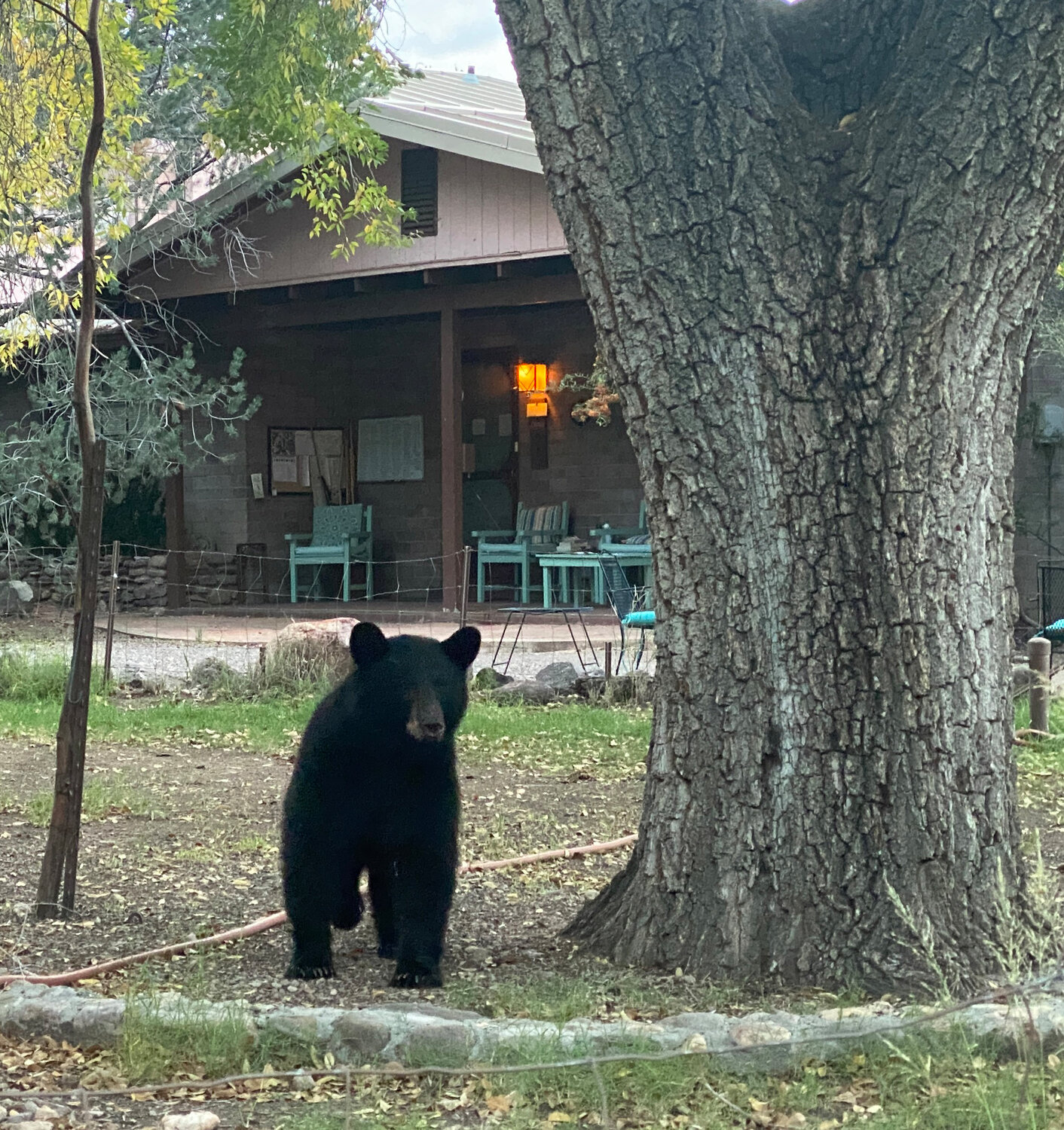
In the far southeast, where Cave Creek Canyon is located, the rain never hit. And for weeks prior, it never reached there either, causing the worst period of drought many longtime residents had ever witnessed. What I first admired as changing fall colors on trees on the canyon wall I soon learned were actually trees that had died from the drought. And my beloved Cave Creek Ranch was different than the last two times I’ve been there. The dead vegetation and scarce food sources had driven the bears down into the canyon where they were raiding bird feeders and causing destruction to property. The owners at Cave Creek Ranch, like most residents in the canyon, had stopped feeding birds to avoid attracting bears. Thus the normally active nature scene of birds and bats coming to the feeders and coatimundi, raccoons and skunks picking up scraps had instead become, “Watch out for bears.” Every day we saw the same black colored bear roaming past our cabin, but it was not thought to be a “nuisance bear." Sadly, a larger brownish colored bear started tearing into the cabins and people’s cars and had to be euthanized by authorities.
Despite the absence of feeders to attract wildlife, we still managed to see a lot. A group of javelinas (wild pig relatives) crossed the road at dusk, a coatimundi joined us for our morning coffee and I was able to photograph a rare Chiricahua ground squirrel. I still love it there, bears or not.
At the end of our 10-day trip, we stayed at a hotel in the Arizona Sonoran Desert outside Tucson, and I soaked up another desert dusk and dawn over the cacti. Although the national park was closed due to the U.S. government shutdown, it didn’t impede visitors at all. The main visitor center was still open, at least the gift shop part of it, because it was managed by a concessioner and partly staffed with volunteers, and the park roads were still open. Once again, it worked out for us.
I don’t think Bucko and I will do another long road trip any time soon, at least not for a 10-day stretch. But I will savor every memory from this one. For me, it was perfect, for Bucko not so much. Next vacation, it is his choice!
Pat Foster-Turley, Ph.D., is a zoologist on Amelia Island. She welcomes your nature questions and observations. Patandbucko@yahoo.com


Comments
1 comment on this item Please log in to comment by clicking here
DouglasM
Tombstone? Bisbee? Those were true "wildways"!
Friday, November 7, 2025 Report this