 >
>
America at 250: It's time to put the David Yulee statue in its proper place

"All men are created equal" - The Declaration of Independence
FERNANDINA BEACH — This week, Americans celebrate the 250th anniversary of the Declaration of Independence and its enduring promise that "all men are created equal."
But one of the men we continue to honor in Fernandina Beach spent much of his life fighting to deny that promise to others.
For more than three decades, David Levy Yulee built a vast personal fortune through the forced labor of more than 1,000 enslaved African American men, women and children. He dedicated much of his political career to preserving slavery and ultimately helped organize the secession movement that led to the Civil War.
Yet every day, dozens of visitors stop at the Fernandina Beach Welcome Center. They gaze at the bronze statue of Yulee, read the plaque, snap a photograph and continue on their way believing they have just met the founder of modern Fernandina Beach — a visionary railroad builder, entrepreneur and statesman.
They have.
But they have met only half the man.
Nothing at the Welcome Center tells visitors that Yulee built much of his fortune through enslaved labor. Nothing explains that he spent much of his public life defending slavery or that he became one of Florida's leading organizers of secession.
As America celebrates its 250th birthday, Fernandina Beach should ask itself a simple question:
Is the first historical figure we introduce to visitors still the one we want to honor at our city's front door?
David Levy Yulee was unquestionably one of the most influential men in Florida's early history. He championed the Florida Railroad, transformed Fernandina into the eastern terminus of Florida's first cross-state rail line, served as one of Florida's first U.S. senators and helped shape the state's economic future.
Those accomplishments deserve to be remembered.
But they do not tell the whole story.
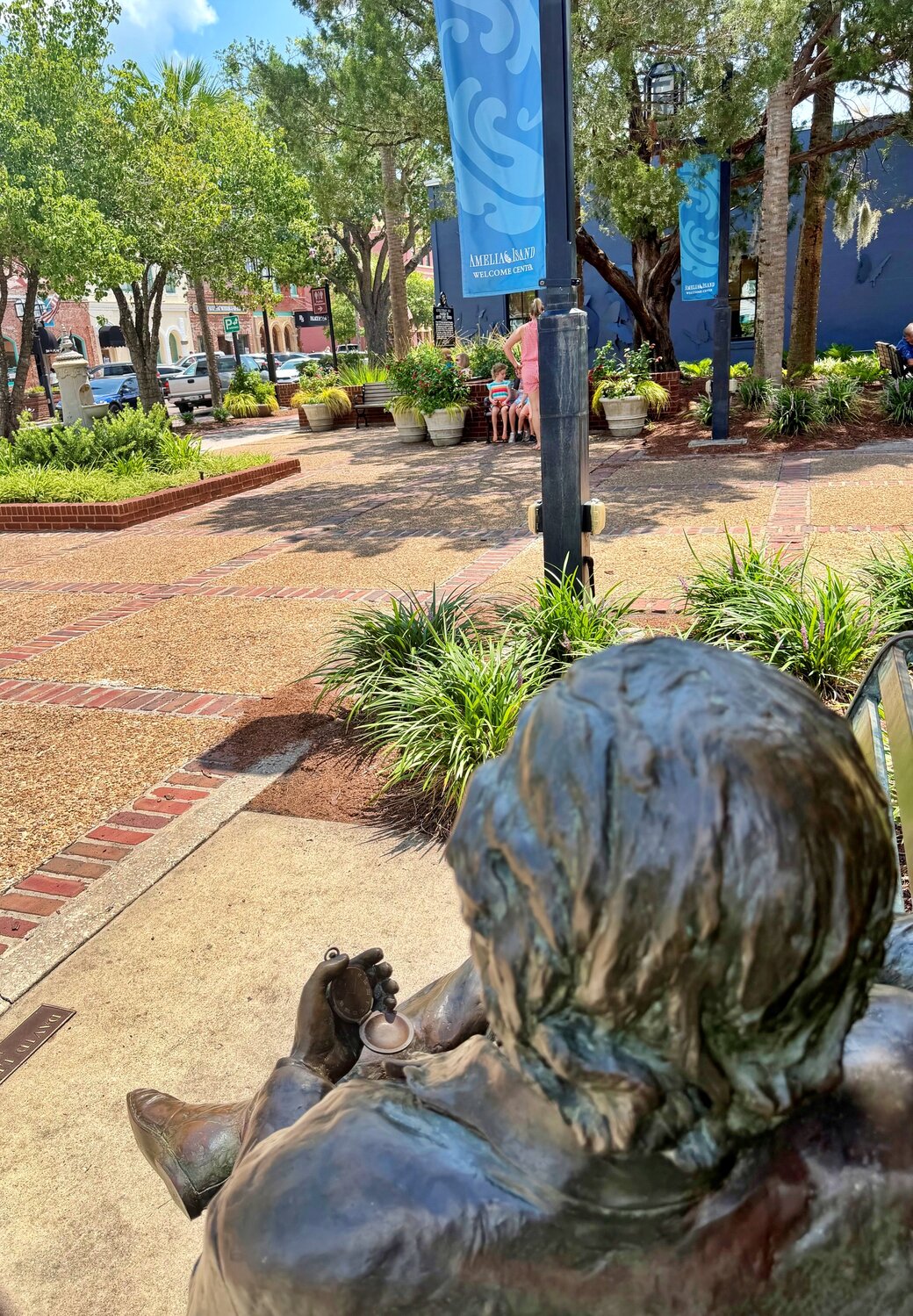
Yulee statue sits next to the Welcome Center banner
Yulee's political defense of slavery was deeply personal because slavery was the foundation of his fortune. Beginning in the late 1840s, he developed the 5,000-acre Margarita Plantation near Homosassa into one of Florida's largest sugar operations. Historical records show that over the course of his life, Yulee owned more than 1,000 enslaved men, women and children, making him one of Florida's largest enslavers.
Those enslaved people cleared forests, drained swamps, dug canals, planted and harvested sugar cane, operated his sugar mill, produced sugar, molasses and rum, and generated the wealth that financed his expanding business empire.
Yulee's business empire was built on slavery at every stage — from those plantation fields to the railroad built in part by enslaved labor that carried those products across Florida, to the port at Fernandina, where they entered national and international markets.
His fortune was not simply accumulated during the era of slavery.
It was created by it.
It should surprise no one that Yulee fought so fiercely to protect the institution that made him wealthy.
During the great Senate debates over the Compromise of 1850, Yulee declared that preserving the rights of slaveholders was "an indispensable condition" of any agreement to preserve the Union. He insisted there could be no compromise unless Congress guaranteed "the right of southern emigrants to carry their slave property into the Territories."
He went even further, arguing that the federal government had a duty "to deal with slaveholders and slave property as with all other citizens and all other property."
To Yulee, enslaved human beings were property whose ownership deserved constitutional protection.
Those are not the words of someone reluctantly accepting the realities of his era.
They are the words of a man vigorously defending the economic system from which he personally profited.
His commitment to slavery did not end in the Senate.
Following Abraham Lincoln's election in 1860, Yulee became one of Florida's principal political organizers of secession. In a confidential letter dated Jan. 7, 1861, to future Confederate General Joseph Finegan, Yulee described a strategy meeting of Southern senators.
"The idea of the meeting," he wrote, "was that the States should go out at once, and provide for an early organization of a Confederate Government."
He also explained why Southern senators intended to remain in Congress temporarily:
"By remaining in our places until the 4th March, it is thought we can keep the hands of Mr. Buchanan tied and disable the Republicans from effecting any legislation which will strengthen the hands of the incoming administration."
This was not the correspondence of a reluctant bystander.
It was the work of a political leader helping coordinate the creation of a government founded to preserve slavery.
After the Civil War, the economic system that had made Yulee rich disappeared forever. The enslaved people whose labor had built his plantation and railroad empire were finally free. Yet more than a century later, Fernandina Beach's public memorial continues to celebrate the railroad builder while largely omitting the enslaved labor that made those accomplishments possible.
None of these facts erase David Yulee's importance to Florida or to Fernandina Beach.
He helped build the railroad that connected the state from coast to coast.
He helped establish Fernandina as one of Florida's most important ports.
He changed the course of Florida history.
Those accomplishments deserve to be studied.
They deserve to be remembered.
But they do not justify a place of honor at the front door of our city.
The statue itself is not a relic of the Civil War or even the early 20th century. It was commissioned and installed in 2014 outside the historic railroad depot. This is not a debate over preserving a historic monument in its original setting. It is a discussion about a modern decision regarding whom we choose to honor and where.
There is an important difference between remembering history and celebrating it.
A museum exists to tell complete stories.
A welcome center exists to celebrate a community and introduce visitors to what it values.
The Amelia Island Museum of History is exactly where the David Yulee statue belongs. There, historians can present him in full: the railroad visionary, the entrepreneur, the U.S. senator, the plantation owner, one of Florida's largest enslavers, the defender of slavery and one of the political organizers of secession.
Visitors would leave understanding the complexity of one of Florida's most consequential historical figures — not a sanitized version of him.
Moving Yulee's statue would not erase history.
It would restore it.
As America commemorates 250 years since the Declaration of Independence proclaimed that all people are created equal, Fernandina Beach has an opportunity to demonstrate historical honesty and civic maturity.
David Yulee should remain part of Fernandina Beach's story.
He simply should no longer be the first story we tell our visitors.
Move the statue to the Amelia Island Museum of History.
Tell the whole story.


Comments
10 comments on this item Please log in to comment by clicking here
Mark Tomes
Well said, Mike, particularly in these times when our federal and state legislators are trying to white-wash our history. Under the guise of not wanting people to feel uncomfortable or wanting to keep the history of our country positive, they are erasing huge parts of our. history that affects all of us to this day. By embracing our country's full history, including slavery, denying women and non-cis people their full rights, suppressing labor organization, etc., we can be proud of the accomplishments that we have made in the past 250 years, aiming to get closer to that ideal of "all men (and women) are equal."
Monday, June 29 Report this
Bob121
It is so easy to judge people of other cultures and historical periods by today's liberal standards. Since you know NOTHING of how the world was 200 years ago, perhaps you should learn more about what life was like back then. It was normal and accepted to employ slaves for work. Ghastly by today's measures. Unheard of within polite social circles of today. Yulee worked with what was legally available to him in that time. While you want to cause our town's true history to become hidden and shameful, most of us would rather celebrate the man who took it upon himself, risking his future, his health, and his fortune, to create the town we now know and love. Can't you just observe and enjoy our history without making a shame of it? Why must you drive a wedge into everything about Southern History? Sure, Yulee wasn't perfect, no one is. Understand that we actually know his story, and would still rather not transform Fernandina into a Northern look-alike town without reference to our sins of the past. Spare us your Better-Then-Thou attitude.
Monday, June 29 Report this
PEPSTEVERSON
Thank you for sharing.
Monday, June 29 Report this
AcurtNA63
He also pioneered rail roading in Fla.
Monday, June 29 Report this
brucebaugh
Aren’t there two options here? 1. As you have suggested, move the statue to the museum, or 2. Why can’t the signage at the Welcome Center be changed to tell the truth about the man?
Monday, June 29 Report this
DouglasM
Mike L.....I don't remember you being around in 2014. If you were, you could have followed the debate the Restoration Foundation had on where to place the statue. The founders of this publication were members of that committee (Sueanne was the Treasurer, I believe). There was concern about Yulee's past regarding slavery; but in the end, they felt he belonged by the old Train Depot and the rail line he helped develop.......not by the old "jail" as you propose. The decision was not made lightly. In particular, the people involved in 2014 were some of the most respected I have ever met in this town.
If you want to "tell the whole story", do as Bruce suggests and add the rest of his history to his current location......but I can't support moving him.
Monday, June 29 Report this
JohnnyMiller
If anyone is interested in more about this individual, research where his post war labor was sourced. Spoiler alert, it's racist af.
Monday, June 29 Report this
PaulaM
Nobody is perfect..true. Nobody today was around in Yulee’s day to tell the exact story. We have historical records to do that. Two things can be true at the same time and one doesn’t counteract or override the other. The significance of welcoming the public to a city or town should be a representation of all the values that town wants to be known for and a heritage it is proud to proclaim. While Mr. Yulee’s accomplishments were vast and important..the means with which history describes him of succeeding in accomplishing them are not something we take pride in today. His statue ..meant to commemorate his success and importance ..should be in a museum as an integral part of the history of the beginnings of Amelia Island with full disclosure of every aspect of his life. However, in today’s world, his past is not representative of the values of the current community therefore it makes it out of place in a center welcoming others to that same community.
Tuesday, June 30 Report this
JeffKennard
The institution of slavery exhausted in ancient Mesopotamia over 10,000 years ago and has continued until the modern era.
Historians and economists argue that enslaved people played an indispensable and foundational role in developing the Western world's infrastructure and wealth.
Let's stop the retrospective and revisionist viewing, evaluating and moralizing about the past with the benefits of hindsight. It's time to cease punishing ourselves for past mistakes that America has learned from and overcome. Ignore the uninformed and biased pundits. Leave our historical statues alone.
Now, is the time to be patriotic and proud of America. We should celebrate its great history as we look forward to an even greater future for all Americans.
Tuesday, June 30 Report this
GDecker
Fernandina was founded in 1856 by Florida's U.S. Senator David Levy Yulee, who relocated the "old spanish town" to serve as the eastern terminus for his cross-state railroad.
Honoring the city founder with a statue on Centre is right, it is respectful of our heritage, and shows "civic maturity".
Let's move on, please.
Thursday, July 2 Report this